
Three Steps to Creative Collaboration with Steph Street
An interview with DR trainer, Steph Street
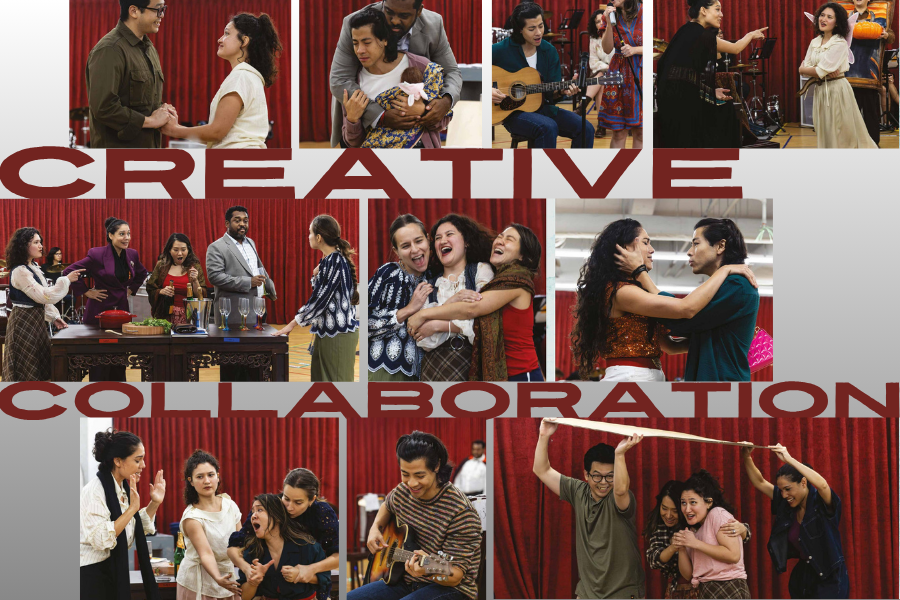
The cast of Force Majeure in rehearsals (Images courtesy of Pangdemonium)
We sat down with Senior Associate, Steph Street, to explore the principles of collaboration and the pursuit of excellence through teamwork. Outside the DR training room, Steph is a successful actor and writer with a wealth of experience in creative collaboration – from rehearsal rooms to the boards of arts charities. She grew up in Singapore.
DR: Thanks for chatting with us, Steph! To kick things off – what are you working on right now?
SS: Recently, I’ve been working on my second collaboration with Pangdemonium in Singapore. I was wondering: “How do we make a play by Chekhov (the late 19th century Russian playwright) feel as if it belongs to Southeast Asian people? People who, like me, might have global cultural references, but come from a specific cultural heritage?” And what we came up with was Force Majeure – a multidisciplinary creative collaboration between the director, the sound designer, my script, and the actors.
DR: What are the first things that you put in place when you're working with a new group to try and establish some trust and a collaborative environment?
SS: I think you need to begin with mindset. The very first thing I try to ask myself is: “what's the spirit I'm walking into this dialogue, or this creative space, with?” I’ve realised that it can be broken down into three principles: benevolence, open-heartedness and rigour.
DR: Would you share that framework with us?
SS: Yes, let’s talk about it. By benevolence, I mean you should be open to the input of others – grateful for, excited by, and positive about the things that other people can bring. Then, open-heartedness. As a writer, your text is the starting offer for a piece of theatre. It's quite easy to feel possessive of something you’ve been pouring over at your kitchen table for the past three years, but that's not the purpose of a collaborative piece. This is particularly true in playwrighting, but I’d argue the same concept applies to any project – in the arts, business or otherwise – which consults multiple experts. The last thing I’d mention is rigour, specifically rigour in the pursuit of excellence. Other people's interrogations, solutions and suggestions can create something exceptional... something bigger than anybody's individual contribution, and better than what you imagined. Likewise, a collaborator will sometimes want to change or cut something. Keeping a rigorous eye on the whole means you can actually defend your vision, and why that thing needs to exist. It applies in both cases. Ultimately, I think all these things – being benevolent, open-hearted, and rigorous – establish trust between collaborators.
DR: There's a tendency, especially among us Brits, to ‘just get along’ and keep the peace. How do you know when collaboration is actually working, rather than just feeling good?
SS: People go further and they take risks during a real collaboration. Otherwise, they tend to be cautious and guarded with what they offer. For the play to have maximum impact, it was essential to keep the stakes high throughout. As the writer, I could set that up by inserting a death on stage right at the beginning. But to maintain the stakes, everyone needed to commit fully. The further down the road we got, the further the actors pushed their emotional investment, and the better and richer and more captivating the drama became. That’s collaboration. It did feel nice, and there’s a lot of positive feedback in the moment; however, each person pushed for greatness through risk-taking and through investing significantly as an individual. If there's protectiveness and suspicion, there is no room for creative collaboration, in my mind.
DR: Giving and receiving feedback is hard. If you’re leading a project, how do you encourage people to challenge your ideas? How do you cultivate that space?
SS: It's very easy to say, “look, I'm open, I'm receptive to feedback”. But actually, it comes down to tiny, unspoken exchanges and dynamics. When you need to build trust and connection very quickly, it’s crucial to take the time to find shared ground. Without getting to know your teammates, it’s even harder to create a space in which they can ask you difficult things, or give you difficult feedback.
DR: You spoke earlier about rigour, and holding oneself accountable. Is there a way to communicate to a group that you, as a leader, are serious about wanting to get the best from a project? That in itself might generate experimentation, pushback, and challenge.
SS: Oh, completely. You might be tempted to rest on your track record and credentials. In the corporate space, there’s an added expectation that we should all be able to confidently summarise our achievements and credentials. It might get you so far, and there might be some value in setting a notional benchmark at the outset of a project. But by concretely stating the project’s end goal before the process of collaboration has occurred, you limit the outcome. You might find your team working towards ticking a box rather than creating something original, something of excellence. It's very hard in the business world, because often new projects are driven by KPIs. Perhaps there really is a tangible, measurable output that's desired from the project! But here’s the rub: I’d argue that a leader can hold that without sharing it. They can choose not to make every deliverable the responsibility of every individual.
DR: What is one tip or exercise to help leaders build a more collaborative process?
SS: There’s a wonderful exercise I often deploy, an expansion of a classic Dramatic Resources exercise. At the start of the day, or the start of a session, try asking everyone to speak for one minute about a work-related moment they were really proud of. Be adamant about making the time for everybody to get their voice into the room. When everyone verbalises a personal, relevant and uplifting experience right at the outset, they are able to invest quickly. They invest in the room, the collaborators around them, and themselves. That can have such a significant outcome. People walk in with pride and with possession of what they're about to do. Of course, there’s value in team-building exercises and bonding games, but this is a short and punchy exercise which is really effective in setting up for success.
DR: We’re going to end with two phrases – stepping up and stepping back. How do you think these connect to the theme of creative collaboration?
SS: Stepping back makes me think about the value of physically stepping out of the room and giving my collaborators the freedom to get fruitful work done. For Force Majeure, I flew out to Singapore for one week at the start of rehearsals. We talked through the script, my intentions and my thoughts while writing it... but then, I left. I've been an actor in a room where writers have stayed around long past their welcome! But trust means you've got to be able to let others do their work with liberty. Once they started running chunks, I would watch them from a distance. I communicated primarily with the director (rather than the whole cast), and mostly via email. We all know how much you lose when not communicating in-person – no body language, no tone of voice etc. So I would carefully consider how I phrased the things that I sent to her, and because of the time difference, I had the space to draft my thoughts a couple of times before messaging. Then the director had to hold the room, and I trusted her to deliver my notes.
DR: It seems like the idea of finding the right container for communication links back to selecting what to share, and with whom.
SS: That’s right. The director and I are both quite different, and it worked for us. I'm quite emotionally driven, especially with something that I’ve made. I found I needed that “second pass” to reflect on what I really wanted to achieve.
DR: How about ‘stepping up’?
SS: When you say stepping up, I think about the courage to be honest and open in communication – being vocal about what worked and didn’t work. It’s imperative to give direct feedback the respect that it deserves in a rehearsal room. Also, I guess because I'm an actor, I often wanted to give someone a moment of recognition for the great work they were doing. I don't think you can ever encourage people too much. In David Mamet’s book, True and False, he argues that a theatre-making community can be the most perfect example of collaboration, because the project is elevated and extended through the group’s ability to complement and challenge. But you have to create the right circumstances for that. It’s kind of a perfect metaphor for leadership!
Thank you so much to Steph for her insightful reflections on creative collaboration. To learn more about Pangdemonium (Singapore), you can follow this link. To find more of Steph’s work outside the training room, click here. Keen to work with Steph or another of our expert trainers on developing a collaborative practice? Drop us an email!